Camera History: From the Camera Obscura to the Smartphone

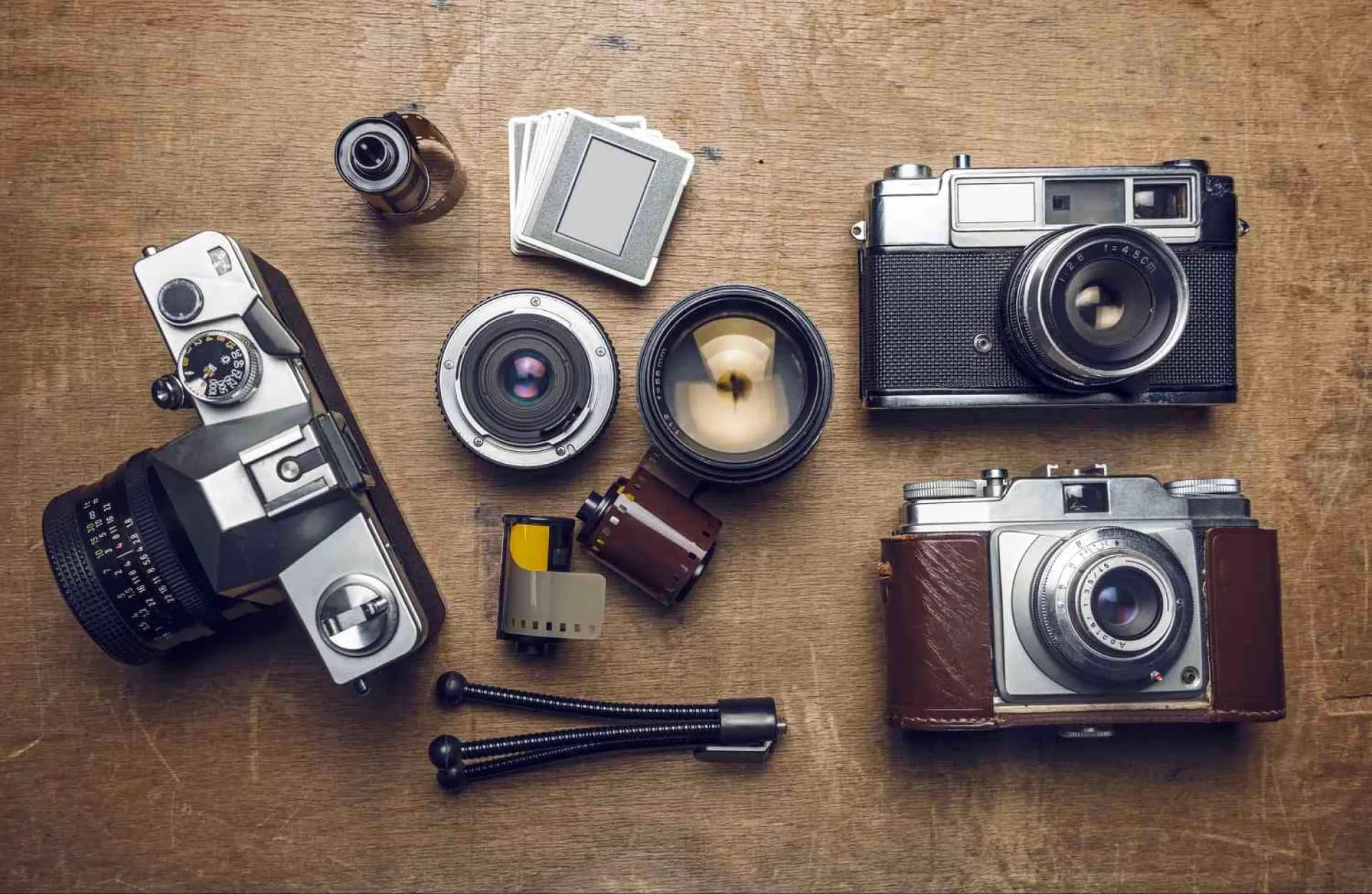
The phone in your pocket descends from a very simple observation: light passing through a small hole into a dark space draws an upside-down picture of the world outside. It took more than two thousand years to go from noticing that effect to fixing an image permanently, and less than two hundred more to put a camera in nearly every hand. Here is that story in eight steps, from the dark room to the smartphone, with a note on what it means for the photos sitting in your family albums.
1. The camera obscura: a picture with no way to keep it

Photo source: My Modern Met
"Camera obscura" is Latin for "dark chamber". The effect was described in ancient China in the writings attributed to the philosopher Mozi, and by Aristotle in Greece. Around the year 1000, the scholar Ibn al-Haytham studied it carefully in his work on optics.
By the Renaissance, artists and scientists were building camera obscuras on purpose, and lenses made the image brighter and sharper. In the 17th century they became portable boxes, used as drawing aids: an artist could trace the projected scene on paper. Johann Zahn described a compact, box-shaped design in 1685 that looks remarkably like a later camera. What none of them could do was keep the picture once the light changed.
2. The first permanent photograph
The missing piece was chemistry. In the 1820s the French inventor Nicéphore Niépce coated a pewter plate with bitumen, a substance that hardens in light, and left it in a camera obscura facing out of his window. After an exposure of many hours, the unhardened bitumen was washed away, leaving a faint image of rooftops. Made around 1826 or 1827, it is the oldest surviving photograph taken with a camera.
3. Daguerreotypes and paper negatives

Photo source: Photography History Facts
Niépce's partner, Louis Daguerre, carried the work on. In 1839 his daguerreotype process was made public: a silvered copper plate made light-sensitive with iodine fumes, then developed with mercury vapour. The pictures were astonishingly detailed, and the Giroux camera built for the process that year is often called the first camera sold commercially. Each daguerreotype was a one-off, though, with no way to copy it.
In England, William Henry Fox Talbot took a different route. His calotype process, patented in 1841, produced a paper negative from which any number of positive prints could be made. That negative-to-print idea would shape photography for the next 150 years, right up to the packets of prints and negatives many Hong Kong families still keep.
Exposure times also tumbled during this period, from minutes to seconds, as lenses and chemistry improved. In 1861 a photograph of a tartan ribbon, taken by Thomas Sutton to demonstrate James Clerk Maxwell's three-colour method, showed that colour photography was possible in principle.
4. Roll film and the Kodak
For decades, photography meant heavy equipment, glass plates and a darkroom. George Eastman changed that. In 1888 he launched the Kodak, a small box camera loaded with a roll long enough for 100 pictures. When the roll was finished, the owner sent the whole camera back to be developed and reloaded. The company's slogan summed it up: you press the button, we do the rest.
In 1900 Kodak introduced the Brownie, a cardboard camera cheap enough for children. Photography had become something ordinary families did, not just professionals.
5. 35mm: small, sharp and portable

Photo source: iPhotography
At Leitz in Germany, Oskar Barnack designed a compact camera that used 35mm cinema film. It went on sale as the Leica I in 1925, and showed that a small negative could still give sharp enlargements. In 1934 Kodak introduced the 135 cartridge, the light-tight canister of 35mm film that anyone could load in daylight. It became the world's standard film size.
The single-lens reflex (SLR), which lets you look through the taking lens itself, matured in Japan after the Second World War. The Asahiflex IIb of 1954 added an instant-return mirror, so the viewfinder no longer went dark after each shot, and the Nikon F of 1959 became a professional workhorse with a whole system of lenses and accessories. Japanese brands would dominate camera making from then on.
For Hong Kong families, this is the era that filled the albums: compact 35mm cameras at birthdays and Lunar New Year dinners, rolls dropped off at the neighbourhood photo shop, and prints collected a few days later.
6. Instant photography
Edwin Land of Polaroid put the first instant camera on sale in 1948. The film carried its own developing chemicals, so a print appeared within about a minute. Later models such as the SX-70 of 1972 produced a print that developed in your hand with nothing to peel away. Fujifilm's Instax range, launched in 1998, keeps the idea alive and is still a familiar sight at weddings and parties in Asia.
7. Going digital
The charge-coupled device (CCD), an image sensor, was invented at Bell Labs in 1969. In 1975 Steven Sasson, an engineer at Kodak, built a prototype digital camera with it. It recorded a black-and-white image of about 0.01 megapixels onto cassette tape, and each picture took around 23 seconds to save.
The first consumer digital cameras reached shops around 1990, with tiny resolutions and high prices. Through the 1990s, image quality rose and prices fell. Nikon's D1 in 1999 made the digital SLR practical for professionals, and by the mid-2000s many families had put their film cameras away for good.
8. The camera in your phone
Phones with built-in cameras appeared in Japan around 2000. The iPhone in 2007 and the smartphones that followed made sharing a picture as easy as taking it. Today's phones combine several lenses, small but capable sensors and heavy computer processing to produce results that were impossible from a pocket device not long ago.
What this means for your family photos
Each step made photography easier and more common, which is why the decades from the 1960s to the early 2000s left so many prints, slides and negatives behind. Unlike the files on your phone, those are physical objects. In Hong Kong's humidity they fade, stick to album pages and grow mould, and a flood or a leaking window during typhoon season can ruin a whole box.
Capture HK scans prints, albums, slides and negatives into high-resolution JPGs you can keep on a USB, share in Google Photos and pass on to the next generation. Photos stuck in albums can be captured in place, without peeling them out. See the options on our photo digitisation page and slides and negatives page.
Capture Reviews
Related Articles
You may also like these articles

Capture · Our team
Any Questions?
Feel free to contact
our Memory Specialists
Not sure what format you have or how best to handle it? WhatsApp us and one of the team will take a look.
WhatsApp us