[Canon AE‑1]Price, Specifications, Reviews, User Opinions (Including Where to Buy in Hong Kong)


The Canon AE‑1 is a classic 35mm single‑lens reflex (SLR) film camera introduced by Canon in 1976. With global sales exceeding 5.7 million units, it is one of the best‑selling SLR cameras in history. Combining shutter‑priority automatic exposure with manual operation, and featuring the Canon FD mount system, the AE‑1 offered photography enthusiasts a professional‑level shooting experience at a relatively affordable price. To this day, it remains a popular entry‑level choice for film photography beginners.
When Was the Canon AE‑1 Released?
The Canon AE‑1 was officially announced and released in April 1976. It was manufactured in Japan by Canon Camera K.K. (now Canon Inc.) and remained in production until 1984. As the first model in Canon’s A‑series SLR lineup, it marked a major milestone in Canon’s entry into electronically controlled SLR cameras.
The AE‑1 was launched during an intensely competitive period for Japanese camera brands in the 1970s and 1980s, with Canon, Nikon, Minolta, Pentax, and Olympus all racing to introduce more automated camera models. The AE‑1 was the first SLR camera to use a microprocessor to calculate exposure data. This innovation allowed Canon to integrate more functions into a smaller body, making the AE‑1 one of the most technologically advanced entry‑level SLRs of its time.
The “AE” in AE‑1 stands for Automatic Exposure, highlighting its electronically controlled exposure system. Supported by an aggressive global marketing campaign, the AE‑1 achieved unprecedented commercial success, with total sales exceeding 5.7 million units, becoming a phenomenon in the SLR market.
Canon AE‑1 Specifications
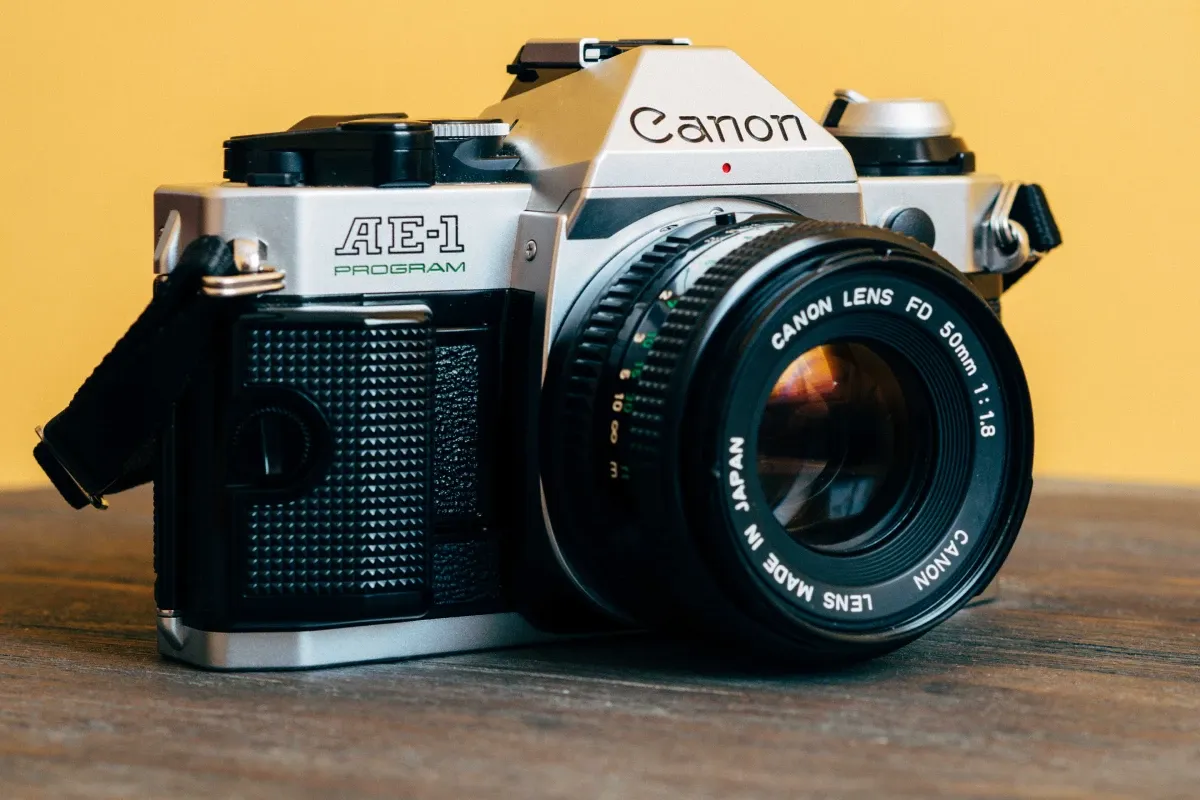
The Canon AE‑1 is a battery‑powered, microprocessor‑controlled, manual‑focus SLR camera that supports shutter‑priority automatic exposure as well as full manual exposure.
Body & Mount
- Lens mount: Canon FD mount, compatible with all FD lenses
- Body material: Metal body with a metallized plastic top cover; available in black or silver
- Dimensions & weight: 141 × 87 × 48 mm; approx. 590 g (body only)
Shutter System
- Shutter type: Four‑axis, horizontally travelling cloth focal‑plane shutter with electromagnetic control
- Shutter speeds: 2 seconds to 1/1000 sec, with Bulb (B) mode; flash sync speed of 1/60 sec
- All shutter speeds are electronically controlled, with a built‑in self‑timer featuring a flashing LED indicator
Exposure Control
- Metering: TTL full‑aperture metering, centre‑weighted average, silicon photocell
- Exposure modes: Shutter‑priority AE or manual match‑needle metering
- Exposure compensation: Up to +1.5 EV
- Metering range (ISO 100, f/1.4): EV 1–18
- ISO range: ISO 25–3200
Viewfinder
- Type: Fixed eye‑level pentaprism
- Magnification: 0.86× (with 50mm lens)
- Coverage: Approx. 93.5% vertical, 96% horizontal
- Focusing screen: Central split‑image rangefinder with microprism collar and Fresnel matte screen
- Viewfinder display: Meter needle, aperture scale, over‑exposure warning, stopped‑down metering indicator, battery check light, and under‑exposure warning LED
Other Features
- Battery: One 4LR44 or 4SR44 (6V). The camera will not operate without a battery, including shutter and metering
- Film advance: Top‑mounted lever
- Frame counter: Additive type, automatically resets when the back is opened
- Film rewind: Top‑mounted rewind crank
Notably, the AE‑1 does not include aperture‑priority mode. This is one of the main differences compared to its successor, the AE‑1 Program, introduced in 1981.
Canon AE‑1 Pricing
As the Canon AE‑1 has been discontinued for over 40 years, only used units are available today. Based on Hong Kong’s second‑hand market data (2024–2025), prices vary depending on condition, accessories, and lens configuration.
Used Camera Kits
- Canon AE‑1 + Canon FD 50mm f/1.8: HK$1,990–2,680
- Canon AE‑1 Program + lens: from HK$1,780
Body Only
- Used body (condition dependent): approx. HK$1,500–2,000
- Collector‑grade or special editions: HK$3,000+
Price Factors
- Cosmetic condition: Approx. 90% condition with lens around HK$1,990
- Functional status: Accurate metering, reliable shutter speeds, and no electronic faults increase value
- Lens included: Kits with FD 50mm f/1.4 SSC are HK$300–500 more than f/1.8 versions
- Accessories: Original lens cap, battery, strap, etc. affect pricing
Compared to its original launch price of ¥81,000 (with FD 50mm f/1.4 SSC), equivalent to around €525 in 2023, today’s second‑hand AE‑1 prices are significantly lower, making it a highly cost‑effective entry point into film photography.
Canon AE‑1 Reviews
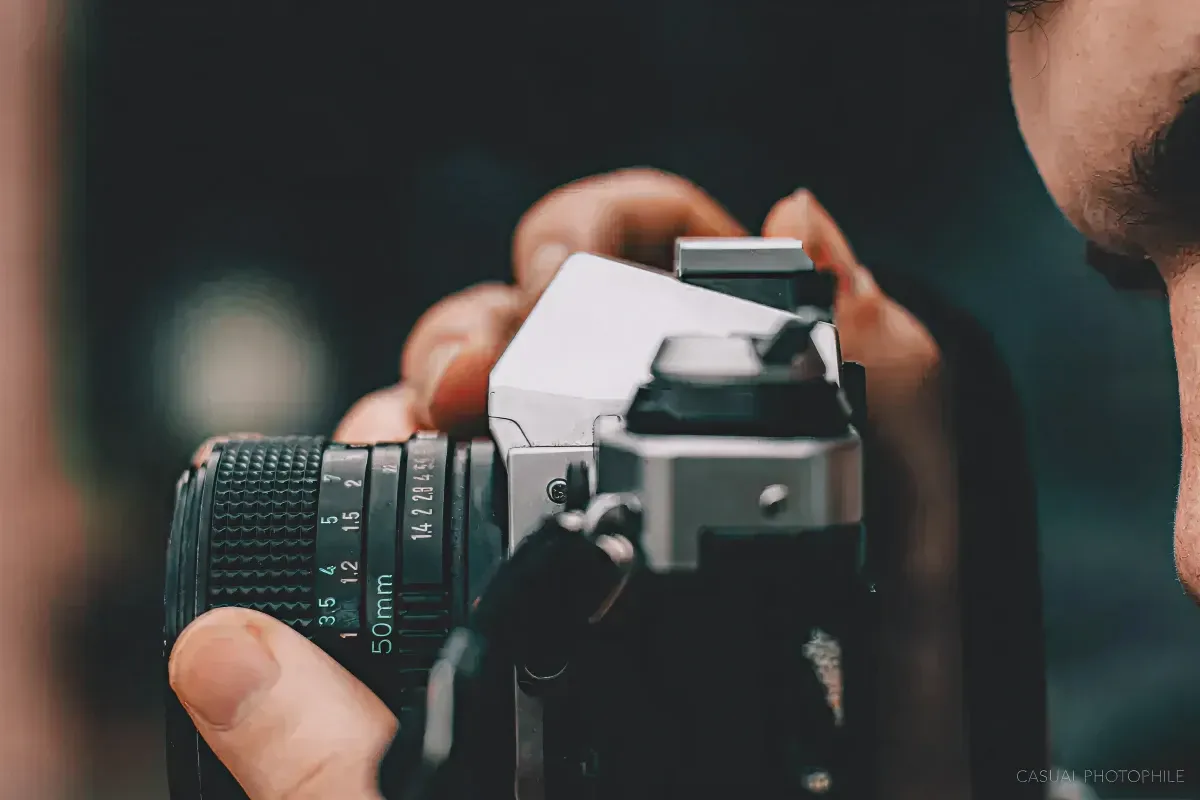
Professional reviews, including those from DPReview, point out that when the Canon AE‑1 was released in 1976, it represented a major technological breakthrough as the first SLR camera to incorporate a microprocessor, making automatic exposure accessible to the mass market. Reviewers generally agree that the AE‑1 is well suited to beginners, as its shutter‑priority mode allows new users to achieve good results without fully mastering aperture control.
Max Kent’s review notes that the AE‑1’s biggest strengths are its affordable price and shutter‑priority functionality, stating that any camera offering both full manual and semi‑automatic modes is a good camera. While the reviewer personally did not favour Canon FD lenses, he acknowledged that the AE‑1 felt too entry‑level for his professional needs. The review also mentions a noticeable amateur feel, with some plastic buttons and dials that lack a premium tactile quality, though it is surprisingly rare to see these plastic components actually fail.
Wit and Folly emphasizes that the AE‑1’s packaging and instruction manual are extremely beginner‑friendly, offering simple “how‑to” guidance that helps newcomers step into the world of 35mm SLR photography. However, the review also points out that Canon made quality compromises to keep costs down, including extensive use of plastic parts and a metallized plastic top cover.
Camera Review by Max awarded the AE‑1 Program a full 5/5 rating, describing it as a highly capable film camera that can often be purchased for under US$200 with a lens. The review highlights its comprehensive automatic features, practical extras such as a battery check indicator and depth‑of‑field preview, and the wide availability of high‑quality Canon FD lenses.
Ken Rockwell, in his comparison between the AE‑1 and the Canon A‑1, notes that the A‑1 typically commands a higher price but is slightly superior overall, largely because it is a newer model with a lower risk of electronic failure. He also considers the A‑1 more attractive in design and superior in metering performance. However, he emphasizes that there is no difference in final image quality between the two when using the same high‑quality lenses, and that their functional differences are relatively minor.
Vintage Camera Digest highlights the AE‑1’s bright and clear viewfinder, equipped with a split‑image rangefinder that is very easy to use. When a subject is out of focus, it clearly appears split into two halves; as the focus ring is turned, the split image gradually aligns, indicating accurate focus.
High5Cameras, in a review titled “Canon AE‑1 Review – Look Out! There’s a Monster Coming!”, suggests that while the AE‑1 is extremely popular, it is not without shortcomings. The review notes that the viewfinder offers approximately 93% coverage, which is considered average (with around 97% on models like the Olympus OM‑1 regarded as high). Nevertheless, the viewfinder is bright and well designed, featuring a matte focusing screen, central split‑image, and microprism focusing ring.
Hong Kong second‑hand camera retailers such as Panda Camera describe the AE‑1 as a “legendary camera that once dominated the market with over five million units sold,” noting its very high visibility and enduring popularity.
Overall, professional reviews recognize the Canon AE‑1’s historical importance in popularizing film photography and automatic exposure. It is widely regarded as an excellent camera for beginners learning exposure fundamentals, while reviewers also caution users about common age‑related issues such as aging electronic components, faulty light meters, and potential light leaks.
What Do Users Say About the Canon AE‑1?
In both Hong Kong and international photography communities, the Canon AE‑1 receives generally positive feedback, especially as an entry‑level film camera.
On Reddit, users have shared experiences of shooting in Hong Kong with Canon AE‑1 cameras inherited from their parents in the 1980s, with comments such as “my first time shooting film!”—reflecting the AE‑1’s reputation as a reliable, heirloom‑quality camera.
Max Kent’s review notes that the most common issues with the AE‑1 involve electronic component failures, including unresponsive light meters or shutters that fail to operate correctly. The review suggests that users refer to the YouTube channel “Fix Old Cameras” for repair tutorials and also cautions users to check for lens fungus or dust, which are common issues across all SLR cameras.
Wit and Folly warns that the AE‑1’s plastic components age over time, including the plastic top cover and areas around the viewfinder. The most frequently reported problem is inaccurate or completely failed metering, often linked to aging capacitors or circuit board issues.
Hong Kong users on forums such as LIHKG generally consider the AE‑1 to be a “beginner‑friendly” film camera. Its shutter‑priority mode allows newcomers to focus on composition and focusing without having to manage aperture settings simultaneously. However, users also highlight several important considerations for beginners:
- Battery dependency: The AE‑1 relies entirely on its battery; without power, neither the shutter nor the meter will function. Carrying a spare 4LR44 battery is strongly recommended.
- Risk of electronic failure: Given the camera’s age of over 40 years, aging electronics are a common concern. When purchasing a used unit, all shutter speeds, meter accuracy, and the self‑timer should be thoroughly tested.
- Light leaks: The light‑sealing foam around body seams deteriorates over time, potentially causing light leaks. Buyers should inspect these areas or budget for seal replacement.
- FD lens compatibility: The AE‑1 uses the Canon FD mount and is compatible with all FD lenses, but it does not support later EF lenses. While this limits modern lens options, FD lenses remain widely available and reasonably priced on the second‑hand market.
Users on Taiwan’s Dcard platform have noted that the split‑image rangefinder on the focusing screen can sometimes be difficult to see, which may pose a challenge for beginners unfamiliar with manual focusing.
Professional photographers observe that while cost‑cutting measures reduced the AE‑1’s price, they also affected perceived durability. Although plastic parts rarely break, the overall build quality does not match that of all‑metal bodies such as the Pentax K1000. That said, the AE‑1’s feature set is more than sufficient for learning the fundamentals of film photography.
Value‑for‑money assessment: Users generally believe that a fully functional AE‑1 kit (including a 50mm lens) can be purchased for around HK\(2,000, offering excellent value for money. Compared with other cameras from the same era, such as the Nikon FM (approximately HK\)2,680) or the Canon A‑1 (similarly priced but more fully featured), the AE‑1 remains competitive in the entry‑level market.
Overall user summary: The Canon AE‑1 is widely regarded as a camera with strengths and weaknesses that are equally apparent. Its strengths lie in its simple operation, affordable price, and wide selection of lenses; its weaknesses include the risk of aging electronic components, complete reliance on battery power, and a plastic‑heavy feel. For beginners on a limited budget who want to experience film photography, the AE‑1 remains a worthwhile option.
Where to Buy the Canon AE‑1 in Hong Kong
As the Canon AE‑1 is long discontinued, no new units are sold through official channels. Buyers can find it via:
Second‑Hand Camera Stores
- YatGyun 一捲 (Wan Chai): AE‑1 Program from HK$1,780
- Panda Camera: AE‑1 + FL 50mm f/1.8 at HK$1,990
- Holiday Camera Store: AE‑1 + New FD 50mm f/2, approx. HK$2,000–2,500
- Filming Lab 光昍工作室: AE‑1 + FD 50mm f/1.8
Online Platforms
- Carousell HK: HK$1,500–3,000 (condition varies)
- Etsy HK: Approx. HK$3,225 with lens
- Price.com.hk: Price comparison listings
Buying Recommendations
- Check camera functionality: Before purchasing, test all shutter speeds (especially slower speeds such as 2 seconds and 1 second), verify light meter accuracy (by comparing it with a known accurate meter), and test the self‑timer and battery check indicator.
- Inspect body condition: Look for cracks in the plastic top cover, ensure the viewfinder is clear and free of fungus, and check whether the light‑seal foam around body seams has deteriorated.
- Lens inspection: Check FD lenses for fungus, dust, or scratches, and ensure the focus ring and aperture ring operate smoothly.
- Accessory completeness: Confirm whether accessories such as the lens cap, body cap, camera strap, and original battery cover are included.
- Warranty or service: Some second‑hand camera shops offer limited warranties; ask about warranty terms before purchasing.
- Price comparison: It is recommended to compare prices across multiple shops, as the same kit can vary by HK$500–800.
Special Editions & Rare Versions
- Canon AE‑1 Program (released in 1981): Adds a fully automatic program mode and offers more complete functionality; used prices are similar to the AE‑1.
- Black body versions: Typically cost HK$100–200 more than silver bodies.
- Kits with original Canon Data Back A (date back): Usually command higher prices.
Best Time to Buy
- During camera fairs or photography equipment exhibitions, when some shops offer promotions.
- Around major holidays such as Lunar New Year and Christmas, when more individual sellers list cameras, providing greater selection.
Important Notes
- Avoid purchasing cameras listed as “untested” or “for parts only” unless you have repair experience.
- Request actual photos from the seller, especially of the camera base, battery compartment, and lens mount.
- For in‑person transactions, bring a 4LR44 battery and a roll of test film to check camera functionality on the spot.
In summary, although the Canon AE‑1 has been discontinued for many years, it remains widely available in Hong Kong’s second‑hand market at reasonable prices. As long as attention is paid to the condition of electronic components and overall body integrity, it is still possible to acquire a reliable and durable classic camera—making it an ideal entry‑level choice for experiencing film photography.
Preserve Your Precious Memories with Capture’s Photo Album Digitisation Service
Do you have a box full of old photographs, worried that they may fade or get damaged over time? Now, you can preserve these treasured memories by digitising them with Capture.HK’s professional photo album digitisation service. Our service allows you to convert your old photos into high-quality digital files, ensuring they are safely stored and easily shareable.
At Capture.HK, we use high-resolution scanning technology to restore your photos with sharp details and vibrant colours, maintaining their original quality. We also offer various file formats, making it easy for you to access and share them across different devices. Most importantly, we handle your photos with utmost care, ensuring they are safely processed and preserved.
The Frame Digital Photo Frame
Want to relive your digital memories every day? Capture’s The Frame digital photo frame is the perfect solution! Designed to showcase your most cherished moments, The Frame allows you to display a lifetime of memories in one elegant frame.
With its sleek design and high-resolution display, The Frame offers an effortless way to organise and enjoy your favourite photos. Simply digitise your photo collection, upload them to The Frame, and enjoy your memories anytime, anywhere.
Whether placed in the living room, bedroom, or office, The Frame adds a touch of warmth and personality to your space. More than just a decorative item, it’s a meaningful gift that brings your treasured moments to life.
Get The Frame today and enjoy your memories every day!
References:
- Canon Camera Museum - canon
- Boss’s Personal Recommendation Ep. 1|Canon AE‑1: A Film SLR Marking a Major Leap in High‑Tech Innovation – camerahoney
Extended Readings:
- [Fujifilm instax mini 90 NEO] Price, Specifications, Reviews, User Opinions (Including Where to Buy in Hong Kong)
- [Leica SOFORT 2] Price, Specifications, Reviews, User Opinions (Including Where to Buy in Hong Kong)
- [Polaroid Go Generation 2] Price, Specifications, Reviews, User Feedback (Including Where to Buy in Hong Kong)
Capture Reviews
Related Articles
You may also like these articles







Capture · Our team
Any Questions?
Feel free to contact
our Memory Specialists
Not sure what format you have or how best to handle it? WhatsApp us and one of the team will take a look.
WhatsApp us